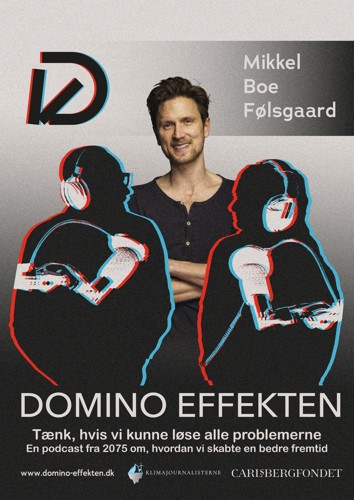
That is the premise of Klimajournalisternes new podcast Domino Effekten, which recently premiered with a listening cinema event at Gloria, followed by a panel debate with researchers and experts. We attended the launch, drew inspiration from it, and carried that inspiration into our own workshop with 9.A at Guldberg School, where we explored together how young people imagine the future.
The podcast takes us to the year 2075. Here, the hosts Daniel and Divya look back on the great transformation that began in 2025. The shift that turned the world away from the brink. Through archival interviews with researchers from our present and short science-fiction stories brought to life by actors Mikkel Boe Følsgaard and Marie Bach Hansen, the series unfolds a possible future: a future where we succeeded.
The podcast does not try to predict the future, but instead to show one possible path forward. The first episode focuses on the economy. If we are to solve the climate crisis in a fair and democratic way, it will require a fundamental transformation of our financial systems. The economy is the first domino. When it falls, a chain reaction can begin.

But how does that story sound to those who will actually be living in 2075?
That is something we at GRASP wanted to explore. If we are talking about transformation, systemic change and new economic logics, it is crucial to listen to the generation that will live with the consequences of the choices we make today. Young people are already living with the climate crisis as a basic condition. They are navigating technological shifts, geopolitical uncertainty and a constant pressure of information. Their hopes are not abstract; they are rooted in our reality right now.
That is why we visited 9.A at Guldberg School.
We played the first episode of Domino Effekten in the classroom and then asked the students to respond to three statements:
- In 2075 I hope that we…
- A hopeful future requires…
- The most important thing we need to do now is…
The exercise was simple: if we imagine that we succeeded, what would it have required? And what does that mean for the choices we make today?
The students wrote their answers on postcards. Not as experts, but as citizens of the future we are talking about.
For us, it is not only about hearing young people’s concerns. It is about taking their imagination seriously as a resource. When we work with hope at GRASP, it is not as a feeling, but as a practice. Something that can be trained, explored and translated into action.
And that is precisely why it makes sense to let a podcast about systemic transformation meet a classroom full of 15-year-olds’ reflections on what really matters.


Reading through the postcards, some clear patterns begin to emerge. First and foremost, there is a strong desire for peace. Many imagine a future with fewer wars, less division and less oppression — a world with less poverty and greater justice. There is a fundamental longing for stability, but also for fairness.
The climate carries just as much weight. The students write about taking care of the planet, protecting nature and recognising that the choices we make today shape the future. There is a clear understanding that the climate crisis requires action now, and that responsibility does not lie with politicians alone, but with all of us.
Technology also plays an important role. Artificial intelligence is mentioned several times, both as an opportunity and as something that must be governed. For 9.A, AI is a central part of the conditions shaping the future.
Finally, many reflections revolve around relationships between people: equality, respect and less discrimination. There is a desire to understand one another better and to stand together, especially when things are difficult.


One of the most striking things is how precisely the students’ reflections echo the podcast’s core idea.
Domino Effekten argues that we need a systemic transformation, particularly of our economic structures. In the classroom, the same point is expressed in a different language. Here it is about collaborating, changing attitudes, taking responsibility and standing together. About caring for the planet and for one another.
The students do not talk about financial reforms or macroeconomic models. They talk about action, community and justice. And about the values that must underpin change if it is to succeed.
Perhaps this is where an important insight lies. An economic transformation is not only a technical project. It is also cultural, social and human. It begins with how we understand our responsibility and with the communities we choose to build.


What makes Domino Effekten distinctive is that it chooses to tell the story as if we succeeded. Not to make reality simpler, but to explore what it would actually take to turn things around. Hope becomes not a feeling, but a method and a way of thinking forward.
We see the same in the postcards from 9.A. Their hopes are not naive. They are concrete. They know there is war. That there is a climate crisis. That AI can run out of control. But they insist that we can do something about it.
If the economy in the podcast is the first domino, then imagination may be the force that makes it fall.
Domino Effekten
Domino Effekten is a new podcast series by Klimajournalisterne, supported by the Carlsberg Foundation.
From a podcast studio in 2075, the hosts look back on the transformation that began in 2025 and changed the course of the world. The series combines interviews with researchers and experts with science fiction storytelling and atmospheric sound design.
The podcast was launched on 23 February 2026, with new episodes released on the following seven Mondays.
Domino Effekten can be heard at domino-effekten.dk and in all podcast apps.